


Talent frameworks have never been short of shapes.
T-shaped. Pi-shaped. Comb-shaped. M-shaped.
Each has helped organisations think differently about depth, breadth and the capabilities required to perform in increasingly complex environments. But AI is changing one part of the equation in a way that traditional models do not fully capture.
The question is no longer only how deep someone’s expertise is, or how broadly they can work across functions.
It is increasingly about how effectively they can extend that expertise with AI.
This is the thinking behind A-Shaped Skill.
Not as a replacement for established talent models, but as an additional capability layer for an AI-enabled workplace.
What Is A-Shaped Skill?
A-Shaped Skill brings together three capabilities:
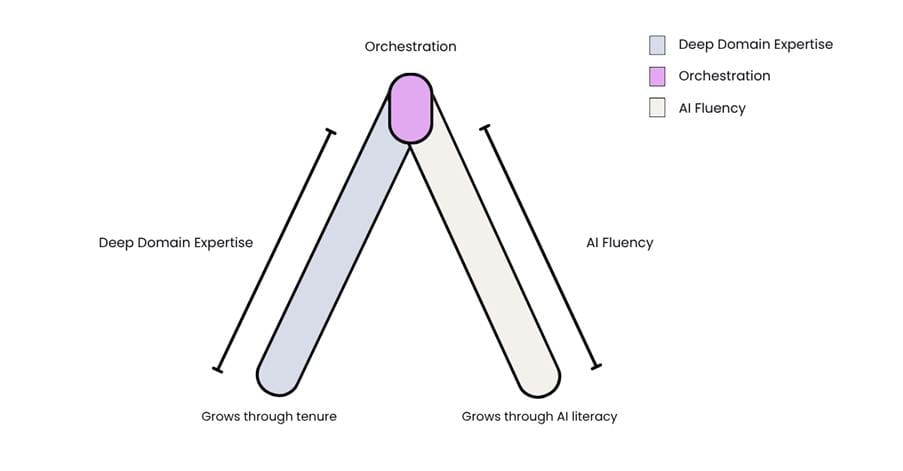
- Deep domain expertise. The foundation. The ability to understand a discipline deeply enough to make sound judgments.
- AI fluency. Not simply knowing how to use AI tools, but understanding where AI can improve the speed, quality or economics of work.
- Orchestration. The ability to connect people, information, technology and AI-enabled output to achieve an outcome.
None of these capabilities is particularly new on its own.
What has changed is the relationship between them.
AI is making it possible for professionals to move across some functional boundaries faster than before. A person can now research, analyse, test an idea or build a first version of something without immediately needing another specialist to start the work.
But that does not make them a specialist in another discipline.
It gives them more reach within their own.
Expertise Remains the Anchor
The growing capabilities of AI have not made domain expertise less important.
They have arguably made it more important.
AI can generate analysis, identify patterns and produce recommendations. But someone still needs to determine whether the analysis is relevant, whether the assumptions are sound and whether the recommendation makes sense in the context of the organisation.
Consider a compensation professional using AI to conduct a pay equity analysis.
AI may significantly reduce the time required to analyse the data. But it takes compensation expertise to recognise when a job architecture issue, historical grading decision or data-quality problem could distort the result.
The technology creates speed.
Expertise creates confidence in the outcome.
And this distinction matters. As AI becomes more embedded in professional work, the ability to question an output may become just as important as the ability to produce one.
AI Fluency Is Becoming a Professional Capability
AI fluency is often reduced to prompt engineering or familiarity with a collection of tools.
The more meaningful capability is different.
It is the ability to recognise where AI can create value within a specific role or workflow, and where using it may add little value or create unnecessary risk.
An HR professional may use AI to analyse workforce information or prepare an initial talent report.
A finance professional may use it to explore scenarios or accelerate analysis.
A marketing leader may use it to examine customer data, develop concepts or test different approaches.
The important point is that none of this turns the individual into a specialist in every adjacent function.
It gives them a stronger starting point.
They can explore a question, develop a first view and have a more informed conversation with the specialist when specialist expertise is required.
For organisations, this suggests that AI capability should not sit separately from professional capability. It needs to become increasingly relevant to how work itself is designed and performed.
The Missing Capability: Orchestration
The third element is perhaps the most consequential.
As AI takes on more tasks, the ability to orchestrate work becomes increasingly important.
A business challenge rarely belongs to one function.
A new product may involve strategy, technology, finance, marketing, operations and people. AI may contribute to several parts of the process, but it does not determine how those contributions should come together.
Someone still needs to establish the objective, connect the inputs, challenge the output, involve the right stakeholders and determine when specialist expertise is required.
That is orchestration.
And it is becoming a more important capability as the boundaries between functions become more fluid.
The strongest use of AI may therefore not be about doing more individual tasks. It may be about helping people connect the right capabilities at the right time.
The Risk: Speed Without Depth
There is, however, an important question for organisations.
If AI makes early-career professionals significantly more productive, could it also reduce some of the experiences through which expertise is traditionally developed?
There is a difference between producing an answer and learning how to arrive at a good answer.
Junior professionals have historically developed judgment through repetition: analysing imperfect information, making mistakes, testing assumptions, receiving feedback and gradually learning what to look for.
Some of that work is now exactly what AI can make easier.
That is the opportunity, but also the tension.
If AI performs too much of that foundational work, organisations may gain short-term productivity while unintentionally weakening the development of long-term expertise.
A junior professional who can produce a polished analysis in an hour is certainly more productive. But if they never learn how to interrogate the underlying data, challenge assumptions or recognise an unusual result, what happens when they become the person responsible for making the final call?
This creates a new talent challenge.
The objective should not be to slow AI adoption. It should be to design work so that AI accelerates learning rather than bypassing it.
That will require thoughtful approaches to early-career development, coaching, exposure and accountability.
What Does This Mean for Talent?
A-Shaped Skill is not a new hiring template.
It is a way of thinking about capability.
Organisations can begin by looking at three questions:
Depth: Does the individual have enough domain expertise to challenge an AI-generated answer?
Fluency: Do they understand where AI can meaningfully improve their work?
Orchestration: Can they bring together the right people, information and capabilities to move an outcome forward?
These capabilities will not necessarily develop at the same pace.
Someone may have strong functional expertise but limited AI fluency. Another may be highly comfortable with AI but still developing the depth required to exercise sound judgment.
That is not necessarily a problem.
It is a development conversation.
The mistake would be to treat “AI skills” as one undifferentiated box on a competency matrix. AI fluency without domain depth has limits. Domain expertise without an understanding of how AI can extend it may increasingly leave capability on the table.
The opportunity lies in developing both, while building the judgment to know when another person needs to be brought into the process.
That is why A-Shaped Skill is better viewed as a development lens than a rigid competency model.
Extending Expertise, Not Replacing It
The future of work will not be defined simply by how many tasks AI can perform.
It will be shaped by how effectively organisations combine human expertise, AI capability and cross-functional collaboration.
The workplace does not need fewer experts.
It needs experts who can extend their reach.x“
A-Shaped Skill captures that opportunity: the ability to take deep professional expertise, apply AI intelligently, and orchestrate the capabilities required to turn insight into action.
Expertise provides judgment.
AI provides leverage.
Orchestration turns that leverage into organisational impact.
The organisations that understand this distinction will be better positioned not only to adopt AI, but to rethink how talent, roles and capabilities create value in an AI-enabled workplace.